The dream of living in Lakewood Ranch is often centered on the seamless transition between your home’s interior and the lush Florida landscape. However, the reality of maintaining that indoor-outdoor lifestyle comes with unique challenges. Between the intense humidity, the relentless summer heat, and the proximity to neighbors, choosing the right screening material is a critical decision. Whether you are renovating your existing lanai or planning a new enclosure, the debate between Florida Glass and standard mesh is one that every homeowner must navigate to achieve the perfect balance of comfort, privacy, and durability.
The Outdoor Living Dilemma in Lakewood Ranch
Why Your Screen Choice Defines Your Lanai Experience
Your lanai is more than just a porch; it is the heart of your home where you spend weekends, host dinners, and enjoy the Florida breeze. If your screen is too dense, you feel boxed in, losing the connection to your backyard view. If it is too light, you face constant exposure to insects, debris, and the prying eyes of neighbors. Your screen choice serves as the primary barrier between your living space and the elements. By selecting the right material, you dictate the atmosphere, temperature, and functionality of your outdoor living area for years to come.
Navigating the Southwest Florida Environment: Salt Air, Humidity, and Heat
Lakewood Ranch presents a demanding environment for any exterior installation. Salt air from the nearby Gulf can accelerate the degradation of low-quality materials, while the extreme summer heat tests the structural integrity of your screen tensioning. Humidity also plays a significant role in promoting the growth of mold and algae on screen surfaces. Understanding these factors is essential, as the material you choose must be resilient enough to withstand the local climate without requiring constant, labor-intensive maintenance.
Understanding Standard Mesh: The Traditional Choice
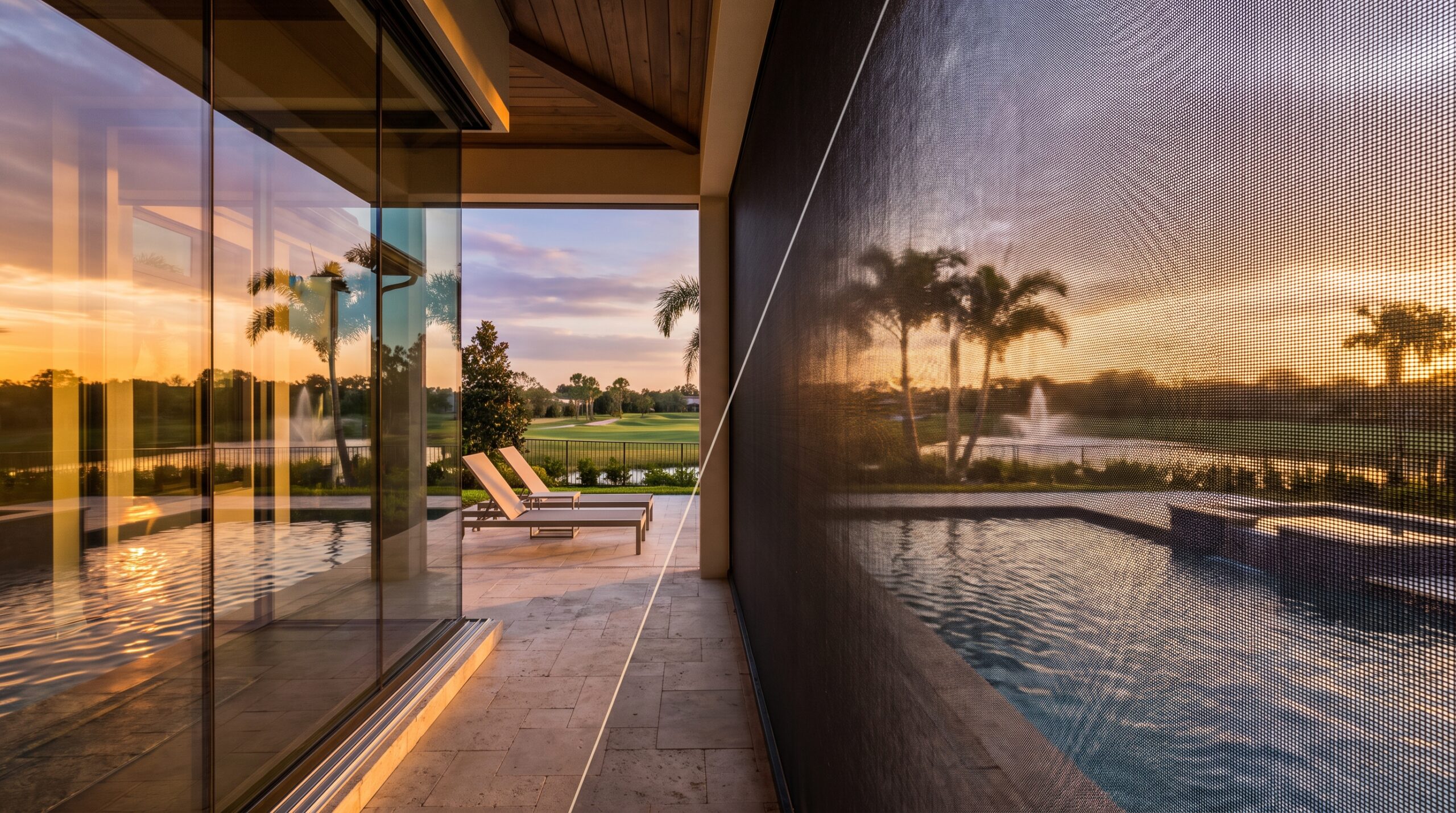
 Standard mesh offers maximum airflow and visibility, while heavy-duty options like TuffScreen provide thicker weaves to resist damage from pets and high traffic.
Technical Specs: Phifer Mesh and TuffScreen Durability
Standard mesh is the industry workhorse. Brands like Phifer have set the benchmark for longevity by utilizing vinyl-coated fiberglass, which provides the necessary flexibility to resist tears while maintaining shape. TuffScreen, a popular variant, offers enhanced durability for homes with pets or high-traffic areas, featuring a heavier-duty weave that is significantly more resistant to accidental damage. These materials are engineered to be lightweight, ensuring that your enclosure frame remains stable while keeping the screen surface taut.
The Primary Advantage: Maximum Airflow and Visibility
The primary allure of standard mesh is its transparency. It offers a “barely there” aesthetic that keeps your lanai feeling open and expansive. Because the weave is engineered for optimal airflow, it allows cool breezes to circulate freely, which is vital during humid Florida months. For homeowners with golf course views or expansive lakefronts, standard mesh is the gold standard because it ensures the barrier never compromises the beauty of the surrounding environment.
Limitations of Standard Mesh in High-Traffic Areas
While aesthetically pleasing, standard mesh has its weaknesses. It is a permeable material, meaning that fine particles, dust, and even light mist can pass through the gaps. In areas where you might want more seclusion, standard mesh leaves you entirely exposed. Furthermore, while high-quality options are durable, they are still susceptible to “brittle spline” syndrome—where the rubber component holding the mesh to the frame degrades under high UV exposure—leading to sagging or screen detachment over time.
What is Florida Glass? More Than Just a Privacy Screen
The Anatomy of Florida Glass: Laminated Vinyl Protection
Florida Glass is technically not glass at all. It is a high-strength, reinforced fiberglass screen laminated with a thin layer of vinyl. This unique composite creates a solid, translucent barrier. Because it is non-permeable, it acts as a windbreak and a privacy screen, stopping dust, debris, and rain from entering your patio. It effectively turns a standard open-air screen room into a more sheltered, semi-enclosed living space.
Aesthetic Appeal: Enhancing the Exterior Look of Single-Family Homes
Beyond its utility, Florida Glass provides a polished, finished look to the exterior of single-family homes. Many homeowners in Lakewood Ranch utilize Florida Glass on the lower panels of their enclosures to hide pool equipment or as a privacy screen on side-facing walls. It creates a sleek, cohesive visual line that hides the clutter of a lived-in patio, elevating the overall design of your property.
How Florida Glass Functions as a Shield Against Storm Rain and Debris
During the summer, Florida is prone to sudden, driving rainstorms. Standard mesh will let that wind-driven water pass right through, potentially soaking your patio furniture. Florida Glass acts as a solid shield, deflecting rain and preventing the accumulation of dirt and leaves that typically blow into an open screen enclosure. This makes it an ideal solution for outdoor kitchens or areas where you keep sensitive equipment that needs protection from the elements.
The Privacy and Security Factor
Creating a Secluded Oasis: Why Florida Glass Wins for Privacy
In high-density developments, privacy is a luxury. If your lanai is situated close to a neighbor’s window, standard mesh provides little comfort. Florida Glass creates a visual block, allowing you to enjoy your coffee or a book without feeling observed. It turns your enclosure into a private retreat, effectively extending the interior privacy of your home into your outdoor space.
Enhancing Security: How Screen Choices Impact Home Perimeter Safety
While no screen is a substitute for a security system, the material choice matters. Standard mesh is easily cut, providing zero resistance to intrusion. While Florida Glass is not bulletproof, its laminated structure is significantly harder to tear or penetrate quietly. It serves as a psychological and physical deterrent, making your patio perimeter feel more substantial and secure.
Integrating Modern Security Solutions with Your Lanai Design
When designing your enclosure, consider a “hybrid” approach. Use Florida Glass on lower-level panels or walls facing public paths to maximize security and privacy, while using standard mesh on the upper panels to keep the view open. This strategic integration allows you to meet your security needs without losing the airy, open feel that makes Florida living so desirable.
Environmental Resistance: Hurricane Loads and UV Protection
Compliance with the Florida Building Code for Pool Enclosures
Every screen installation in this region must adhere to the Florida Building Code. These codes mandate that frames be engineered to withstand specific wind loads. While the screen material itself isn’t a “hurricane shutter,” the way it is installed—specifically the spline tensioning and frame anchoring—is critical. Proper installation ensures that your screen enclosure doesn’t act as a sail during high winds, which could lead to structural failure of the entire cage.
Managing Hurricane Wind Loads: Structural Integrity Differences
Florida Glass creates more surface area for wind to push against compared to open mesh. Because it is non-permeable, wind cannot pass through it. Consequently, homes using significant amounts of Florida Glass must have reinforced frame structures to compensate for the added wind pressure. This is a vital technical detail that requires professional oversight during the design phase.
The Role of UV Inhibitors in Preventing Screen Degradation and Brittle Spline
The harsh Florida sun is the leading cause of material failure. High-quality screens are treated with UV inhibitors that prevent the fibers from becoming brittle and snapping. This is particularly important for the “spline”—the rubber cord that secures the screen in the frame. If the spline is not UV-protected, it will crack and fall out, leading to the dreaded “sagging screen” look. When selecting your materials, always prioritize UV-rated components.
Addressing the Pest Problem: Beyond Mosquitoes
The Cuban Treefrog Invasion: Keeping Invasive Species Out of Your Patio Space
The Cuban Treefrog has become a significant nuisance in Southwest Florida. Unlike local frogs, these invasive species are aggressive, secrete toxins, and can easily squeeze through standard mesh. If you are tired of finding frogs on your walls or in your pool area, standard mesh is no longer enough. A tighter, specialized “no-see-um” mesh or a partial Florida Glass installation provides the necessary barrier to keep these pests out of your living space.
Tight-Weave Solutions vs. Florida Glass Barriers
For homeowners who prioritize insect control, tight-weave screens are excellent, but they do reduce airflow. Florida Glass is the superior barrier for excluding crawling insects entirely, as it lacks the gaps that small pests exploit. By placing Florida Glass at the base of your enclosure, you block the primary entry points for lizards, frogs, and insects, creating an effective, low-maintenance seal.
Protecting Your Lanai from “No-See-Ums” and Local Wildlife
“No-see-ums” (biting midges) are a staple of the Florida summer. Standard mesh is often too coarse to stop them. If you live near standing water or wetlands, investing in a tighter mesh grade is mandatory. Alternatively, using Florida Glass near the base and tight-weave mesh on the upper panels offers a dual-layer of protection that keeps even the smallest pests at bay while maintaining some ventilation.
Temperature Control and the Lakewood Ranch Summer
Summer Days on the Lanai: Airflow vs. Solar Heat Gain
The goal of any patio design is to maximize comfort during the hottest months. Standard mesh allows for maximum cross-ventilation, which helps dissipate heat. However, it offers no protection from solar radiation. Florida Glass, while blocking airflow, can also act as a shade, reducing the direct solar heat gain that reaches your patio surface, keeping the area cooler during the midday sun.
Energy Efficiency: How Florida Glass Can Reduce Heat Radiating into the Home
If your lanai is directly adjacent to large glass doors or windows, the heat that builds up on your patio can radiate into your home, increasing your cooling bills. By installing Florida Glass, you create a buffer zone that limits the amount of heat hitting your home’s exterior walls. This small design choice can have a measurable impact on your interior temperature control, making your home more energy-efficient during the summer.
Maximizing the Utility of Your Gazebo or Patio Space Year-Round
By choosing materials that address both privacy and climate, you can use your patio in more conditions. A hybrid design that incorporates both Florida Glass and high-airflow mesh allows you to optimize your outdoor experience. You gain a sheltered corner for dining and a ventilated, open view for relaxation, effectively doubling the functionality of your outdoor space.
Maintenance and Longevity: Keeping Your Enclosure Pristine
The Battle Against Algae and Mildew in Florida’s Humidity
Florida’s humidity is a breeding ground for algae and mildew. Regardless of the material, keeping your screens clean is essential for longevity. Florida Glass is generally easier to clean as it can be wiped down with a soft cloth and mild soap, whereas mesh requires more careful pressure washing to avoid damage. Regular maintenance, such as rinsing your screens during the off-season, will prevent dirt buildup and ensure that your investment stays looking brand new for years.
Conclusion
Choosing the right screen for your Lakewood Ranch home is a balance of aesthetic preference, functional needs, and environmental reality. While standard mesh offers the classic, breezy Florida experience, Florida Glass provides the privacy, durability, and pest control that many modern homeowners require. By understanding the unique performance characteristics of each material—and considering a hybrid installation to capture the benefits of both—you can transform your lanai into a sophisticated, year-round oasis.
Remember that the quality of your installation is just as important as the material itself. Proper tensioning, high-quality UV-resistant splines, and expert frame engineering are the final pieces of the puzzle that ensure your enclosure withstands the test of time. We encourage you to visit our project gallery page on our website to see these materials in action. Whether you are looking for a complete screen replacement or a custom upgrade, taking the right action today will guarantee a more comfortable, private, and secure outdoor living experience. If you are ready to explore your options, reach out to our team to schedule a consultation and take the first step toward perfecting your home’s exterior.