Living in Lakewood Ranch offers a quintessential Florida lifestyle—sun-drenched afternoons, vibrant communities, and the seamless transition between indoor comfort and outdoor living. For many, the centerpiece of this experience is the pool cage. Yet, beneath the aesthetic appeal of these aluminum structures lies a critical, often overlooked reality: your pool enclosure is a complex engineered asset, not merely a screen against insects. As our climate patterns shift and the Gulf Coast faces more intense storm conditions, the structural integrity of your enclosure has become a significant factor in property valuation and insurance insurability.
The urgency to address your pool cage’s condition has never been higher. With the introduction of the 2023 Florida Building Code (8th Edition), the standards for wind resistance and structural design have evolved significantly. This guide serves as your roadmap to navigating these regulations, ensuring your home remains both safe and compliant in the face of an unpredictable climate.
Understanding the 2023 Florida Building Code (8th Edition) for Lakewood Ranch
Why the 8th Edition Matters for Your Home’s Value and Safety
The 8th Edition of the Florida Building Code (FBC) represents a modern, rigorous response to the lessons learned from recent catastrophic weather events. For a homeowner in Lakewood Ranch, this is not just technical jargon; it is the benchmark by which your home’s safety is measured. When you prioritize compliance with the 8th Edition, you are essentially fortifying your property against the unique atmospheric pressures of Southwest Florida. Ensuring your enclosure meets these updated standards preserves your home’s resale value, as prospective buyers—and their insurance providers—are increasingly wary of outdated, non-compliant structures that could become projectiles during a storm.
Wind-Load Standards: Preparing for the Next Hurricane Ian or Milton
 Diagram illustrating the three main aerodynamic forces—lateral force, uplift, and pressure differentials—that modern pool enclosures must be engineered to withstand under the 2023 Florida Building Code.
Florida’s wind-load requirements are among the most stringent in the nation. Under the current code, pool enclosures must be engineered to withstand specific, localized wind speeds—often reaching 140 to 150 mph in the Sarasota and Manatee County regions. These standards account for uplift, lateral force, and the pressure differentials that occur when a structure is subjected to high-velocity winds. If your enclosure was built even a decade ago, it likely does not account for these modern aerodynamic calculations. Failing to update your structural components to meet current wind-load requirements leaves your home vulnerable to failure that could have been prevented with proper engineering.
The Legal Framework: Florida Statute 515.27 and 515.29
The legal landscape regarding residential pool safety is codified in Florida Statutes 515.27 and 515.29. These statutes mandate that residential pools be equipped with specific safety barriers, and while many homeowners view their screen enclosures primarily as a means of pest control, they legally serve as a primary safety barrier. Neglecting the maintenance of your cage is, therefore, not just an aesthetic issue; it is a potential liability risk. Compliance with these statutes ensures that your enclosure performs its legal duty, protecting both the inhabitants of your home and the neighborhood from unauthorized access to the water.
The Anatomy of a Code-Compliant Pool Enclosure
Aluminum Alloys and Structural Design Standards
A code-compliant pool cage is a marriage of material science and precision engineering. Modern enclosures utilize high-strength aluminum alloys designed to resist the corrosive nature of the Gulf Coast’s humid, salt-heavy air. The structural design must account for the specific geometry of the enclosure; long, unsupported spans require thicker aluminum profiles or reinforced truss systems. When contractors install or retrofit an enclosure, they must adhere to site-specific engineering documents that dictate the alloy grade, beam thickness, and overall framework distribution.
Corrosion-Resistant Hardware: Why Fasteners are the Leading Cause of Failure
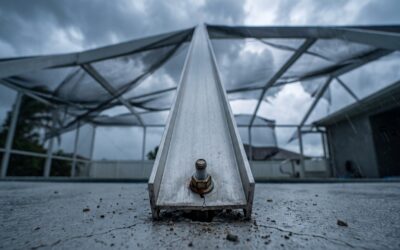
While homeowners often focus on the aluminum framing or the screen mesh, the most common point of failure is actually the fasteners. In the harsh environment of Florida, standard steel screws can oxidize rapidly, losing their tensile strength and essentially “snapping” under stress. Code-compliant enclosures require stainless steel or specialized, high-durability coated fasteners that resist galvanic corrosion. Replacing aged, rusted fasteners with modern, corrosion-resistant alternatives is one of the most effective ways to extend the lifespan of your enclosure and ensure it remains secure when high winds strike.
Structural Bracing and Gusset Plates: The Backbone of Wind Resistance
Gusset plates and structural bracing are the silent protectors of your pool cage. These steel or aluminum plates are strategically placed at the connection points of the framework to provide rigidity and distribute force across the entire structure. Without proper gusseting, the framework acts as a collection of individual sticks rather than a unified, aerodynamic shell. If you notice a “wobble” or shifting in your cage, it is a clear indicator that the bracing is failing. Modern code requires specific bolt patterns and plate thicknesses that must be verified by a building professional during any major repair or replacement.
Florida Glass and Privacy Panels: Code Requirements for Perimeter Enclosures
Many homeowners opt for privacy panels or “Florida glass” (laminated panels) to shield their pool areas. While aesthetically pleasing, these additions alter the wind profile of the enclosure significantly. Because these panels do not allow air to pass through, they create a “sail” effect during a storm, drastically increasing the lateral load on the frame. Consequently, adding these panels requires a specific engineering review to ensure the existing cage can handle the increased wind pressure. Always consult with a permit office before adding solid panels, as an unpermitted modification can lead to structural failure and code enforcement issues.
Navigating Local Compliance: Manatee County vs. Lakewood Ranch HOAs
Working with the Manatee County Building Division
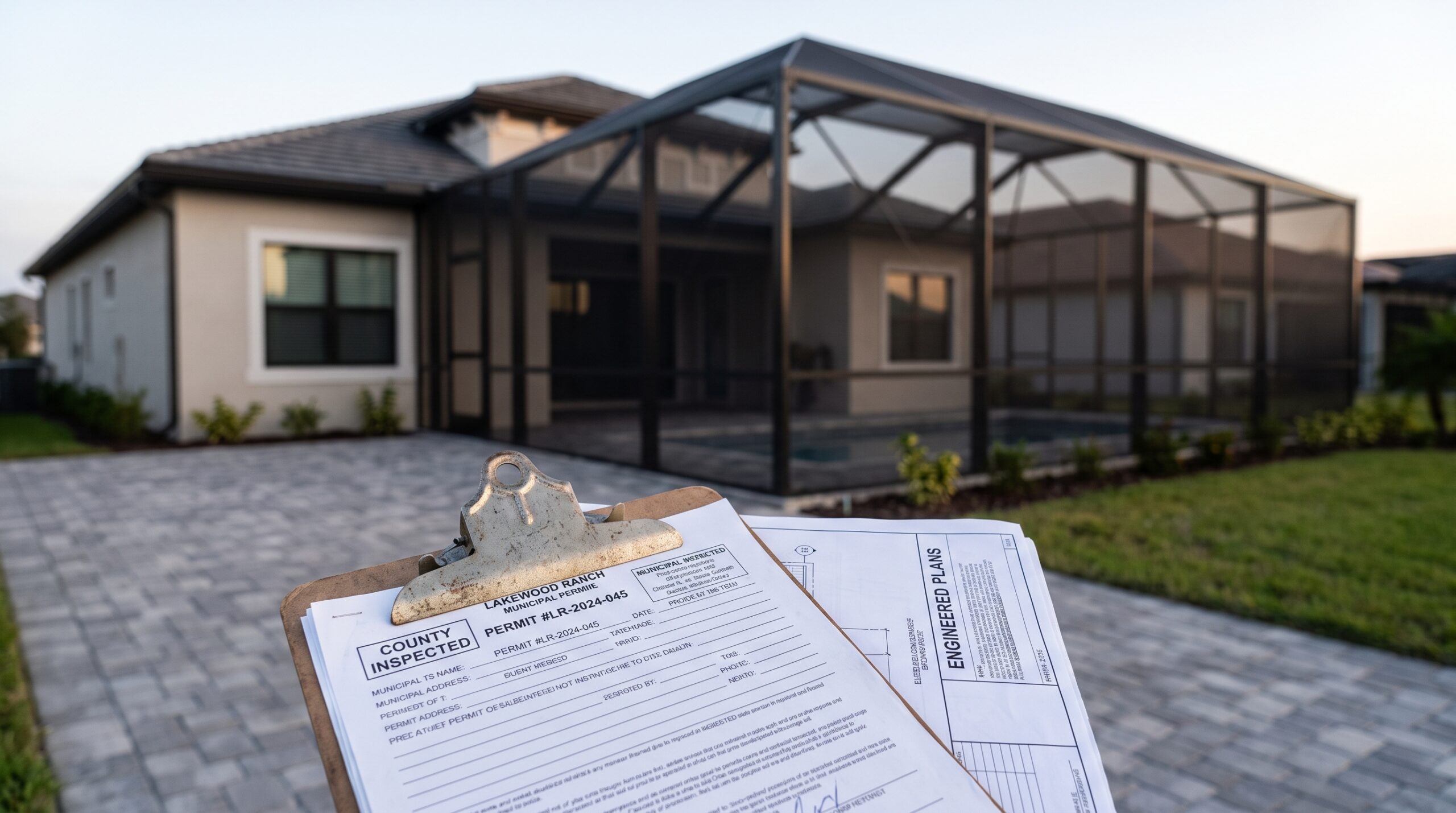
When you plan to modify or replace your pool cage, you are essentially engaging in a construction project that requires a building permit from the Manatee County Building Division. This department ensures that all work complies with the Florida Building Code. While the process may seem bureaucratic, it is designed to protect you. A permit serves as a public record that your structure meets current safety standards, which is vital when filing insurance claims after a storm. Attempting to bypass this process by working with unlicensed or “cash-only” contractors invites significant legal and financial risk.
The HOA Hurdle: Navigating Architectural Review Committees (ARC) in LWR
Lakewood Ranch is famous for its strict aesthetic guidelines, managed by various Architectural Review Committees (ARC). Before you apply for a county permit, you must satisfy the ARC. The committee will look at the color, placement, and visual impact of your cage. They often have specific requirements for screen types and framing colors to maintain community uniformity. Securing ARC approval is a prerequisite to construction, and an experienced local contractor will typically handle this submission as part of their turnkey service, ensuring the design is both code-compliant and community-approved.
Permitting Procedures: Why Professional “In-House” Teams are Essential
The most efficient way to navigate the permitting maze is to work with firms that have dedicated “in-house” permitting and engineering teams. These professionals understand the nuances of the Manatee County building codes and the specific expectations of Lakewood Ranch’s HOAs. By utilizing an in-house team, you avoid the communication breakdowns that often occur when dealing with third-party sub-contractors. They manage the technical drawings, coordinate the structural engineering inspections, and ensure that your project moves forward without the delays that typically plague residential improvement projects.
Is Your Enclosure a Legal Safety Barrier?
Defining “Residential Pool Safety” Under Rule 61G20-1.002
Residential pool safety is governed by Rule 61G20-1.002, which dictates that pool barriers must be sturdy and impenetrable. An enclosure that has rusted through or has panels that have pulled away from the frame does not meet the legal definition of a safety barrier. If a child or pet gains access to the pool through a compromised section of your cage, you could be held liable. Periodic self-audits are essential to ensure that your “barrier” remains a functional safety device rather than a decorative aesthetic feature.
Requirements for Self-Closing and Self-Latching Gates
Your pool cage must feature gates that are fully compliant with local safety ordinances. This means every door leading to the pool must be self-closing and self-latching, with the latch placed at a height inaccessible to young children. If your gate drags on the concrete, sticks, or requires manual assistance to close, it is not just a nuisance; it is an immediate safety violation. Investing in high-quality hinges and hydraulic closers is a small cost that offers immense peace of mind and keeps you in full compliance with state law.
Alarms and Secondary Barriers: When the Enclosure Isn’t Enough
Even with a perfect cage, some local jurisdictions and insurance policies recommend—or require—secondary barriers, such as pool alarms or door chimes that alert you when a door is opened. In Florida, where pools are a central part of family life, layers of safety are the gold standard. Do not rely solely on the screen cage; consider it the first line of defense in a comprehensive safety strategy that includes alarms and monitored surveillance to keep your family and guests secure.
The “Cage Creep” Phenomenon: Assessing Structural Integrity
Recognizing the Signs of Metal Fatigue and Oxidation
“Cage Creep” is a term often used to describe the gradual shifting, sagging, or misalignment of an aluminum cage over time. It is caused by the combination of gravity, repeated wind stress, and oxidation at the connection points. You can spot the early signs by looking at the lines of your enclosure—if the horizontal members are bowing or if the corners no longer meet at precise angles, you are witnessing the effects of metal fatigue. Oxidation, visible as white, chalky residue on the aluminum or orange flaking on the fasteners, is another clear indicator that your cage is nearing the end of its structural life.
How “Cage Creep” Impacts Your Homeowner’s Insurance Claims
When a storm hits, insurance companies evaluate damage based on the structural condition of the property. If an adjuster finds evidence of long-term neglect—such as advanced oxidation, missing fasteners, or “creep”—they may deny your claim, arguing that the failure was due to maintenance issues rather than the weather event itself. Proactive maintenance is the best defense against a denied claim. By documenting your regular inspections and professional repairs, you build a trail of evidence that your property was properly maintained, significantly improving your standing should you ever need to file a claim.
The Pre-Storm Season Compliance Audit: What to Look For
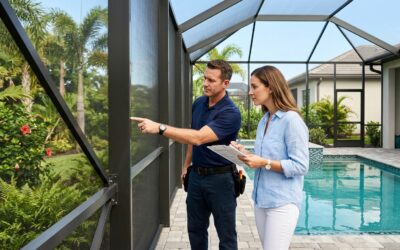
Every year, before the start of the hurricane season, homeowners should conduct a “curb-side” audit. Walk the perimeter of your cage and look for:
- Loose or missing fasteners (look for gaps at the base plates).
- Corrosion around the anchors at the concrete deck.
- Torn or sagging screens that catch too much wind.
- Movement or vibration when the structure is pushed gently. If you find any of these issues, contact a professional immediately. A minor repair performed in April is infinitely cheaper and safer than an emergency repair or full replacement in October.
Strategic Upgrades: Retrofitting vs. Full Replacement
When to Rescreen: Evaluating Phifer Super Screen and No-See-Um Mesh
Rescreening is often viewed as a cosmetic upgrade, but it is also a structural decision. Standard screen mesh offers little resistance to the elements, but premium options like Phifer Super Screen are engineered for increased tear resistance and longevity. If your screens are brittle or faded, they are no longer providing the protection you need. Choosing a high-performance mesh improves the airflow, visibility, and durability of your enclosure, making it a wise investment in the overall longevity of the system.
Structural Retrofitting: Can an Older Cage Meet Modern Wind-Load Codes?
For many Lakewood Ranch homes, a full replacement is not always the only answer. Structural retrofitting involves adding extra bracing, replacing existing fasteners with high-grade stainless steel equivalents, and reinforcing the base anchors to meet the 8th Edition of the FBC. While this is a complex engineering task, it can bring an aging structure into compliance without the cost and disruption of a complete rebuild. A structural engineer can assess your cage to determine if it is a candidate for this cost-effective route.
The Move to Panoramic Open-View Systems: Engineering Challenges and Solutions
Panoramic, or “open-view,” systems are becoming the gold standard in modern Florida home design. By removing vertical mullions and using high-tension, heavy-duty screen panels, these systems provide an unobstructed view of the outdoors. However, these systems require advanced engineering to compensate for the lack of vertical supports. If you are upgrading to an open-view system, ensure that the design is stamped by a licensed engineer, as these structures are particularly sensitive to wind loads and require precise installation techniques.
Material Science: Protecting Your Asset in a Gulf Coast Environment
UV Protection and Longevity: The Role of Advanced Coatings
The Florida sun is unforgiving, and the ultraviolet (UV) radiation rapidly degrades both the aluminum finish and the screen mesh. High-quality enclosures utilize powder-coated aluminum, which provides a durable, UV-resistant shield. When you opt for a professional-grade finish, you are not just choosing a color; you are choosing a protective layer that prevents the oxidation that leads to “cage creep.” Regularly cleaning your enclosure with mild, soap-based solutions removes salt and pollutants, further protecting this finish and keeping your asset looking pristine for years.
Debris Reduction and Maintenance Compliance
While not a formal code requirement, keeping your screens clean and free of debris is critical for structural safety. Accumulated leaves and twigs add weight and, more importantly, turn your screen into a solid surface that catches wind. During a storm, a dirty screen is much more likely to fail because the air cannot pass through it. Incorporating regular power washing or professional cleaning into your home maintenance schedule is a vital component of protecting your structural investment.
Choosing Between Standard Mesh and Hurricane-Resistant Variants
In recent years, hurricane-resistant meshes have gained popularity. While these materials are significantly stronger than traditional screen mesh, they also place more stress on the framework because they do not “blow out” as easily. If you decide to install hurricane-resistant mesh, you must ensure that your framework is reinforced to support the additional load. It is a balancing act of material science—match the screen strength to the structural capacity of the frame, and always consult a professional to ensure your choice is appropriate for your specific enclosure geometry.
Conclusion
The security of your Lakewood Ranch home depends heavily on the condition of your outdoor living structure. A pool cage is far more than an enclosure; it is a critical piece of your home’s infrastructure that requires attention, engineering, and maintenance to survive our unique climate. By understanding the mandates of the 2023 Florida Building Code, respecting the permitting requirements of Manatee County, and staying ahead of the inevitable wear caused by the Gulf Coast environment, you can ensure that your home remains a safe and valuable asset.
The most important takeaway is that you do not have to navigate this process alone. From assessing signs of “cage creep” to managing complex ARC approvals, professional oversight is the key to a stress-free experience. If your enclosure hasn’t been inspected in the last few years, or if you suspect it may not meet the current wind-load requirements, the time to act is now—long before the next storm season arrives. Protect your lifestyle, your property value, and your peace of mind by prioritizing the structural integrity of your pool cage today. Take the step to schedule a professional compliance audit and ensure your home is prepared for whatever the future holds.